
“As the epidemic developed, theories can be found which suggest that influenza was not an individual infection, but in fact simply an ‘influence’, an ‘electrical state of atmosphere’ with the ability to ‘exercise influence’ on the nervous system.”
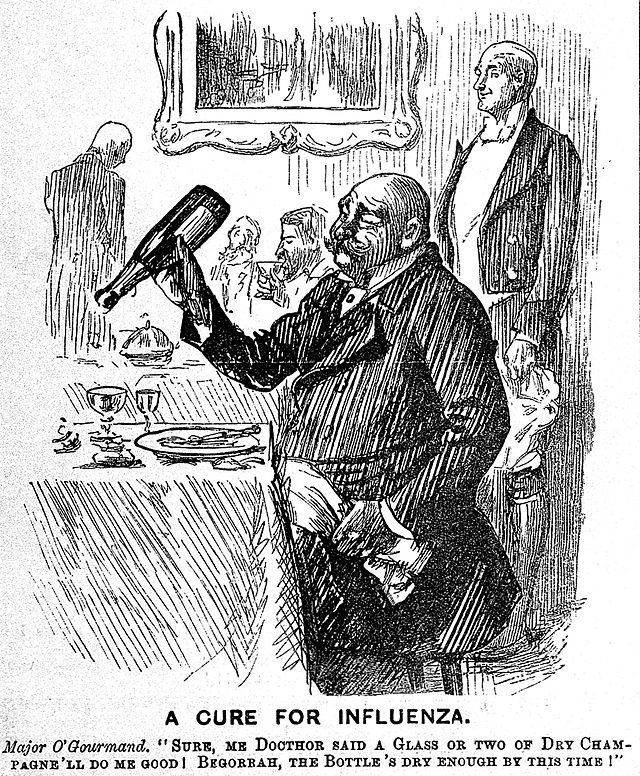
Theories, conspiracies, and misinformation were at the forefront of the public consciousness during the COVID-19 pandemic. From theorising its ‘intentional’ creation, to vaccine discourse, to blaming it on the new 5G networks, the fear of the unknown ran rampant amongst the public, who quickly became distrustful of the information they were receiving. The research conducted in the Media and Epidemics project, which examines the relationship between epidemics and the media used to communicate them, shows us that this is not a uniquely modern problem, but in fact a problem also faced in the heights of the so-called ‘Russian Flu’ pandemic (1889-1895). These conspiracies can be categorised as a fear of foreign influence, a fear of hasty advances in medicine, and a fear of new technological advances that coincided with the beginning of the infections.
Fear of Foreign Influence

There are numerous references to the origin of the Russian Flu in the genre of science fiction, and when examining closely, these include subtle references to other foreign influences that could have contributed to its development or distribution. In W. L. Alden’s ‘The Purple Death’ (1895), the anarchical bacteriologist Professor Schwartz claims explicitly to have developed the recent influenza epidemic, and to have dropped it in St. Petersburg where the epidemic historically began.1 Notably, however, Alden places an emphasis on Professor Schwartz’s German characteristics, assigning him an explicitly German name, and drawing a comparison to Helmuth von Moltke the elder, a real-world Prussian field marshal.2 Furthermore, Professor Schwartz’s potent ‘Purple Death’ is a combination of ‘tuboba venom’ referencing a scarcely researched Central and South American viper, and the ‘Asiatic Plague’, a term used to refer to the cholera pandemic.3 These references all culminate in a figure that appears to be the amalgamation of many different foreign influences that preoccupied the public consciousness of London. Similarly, H. G. Wells’ ‘The Stolen Bacillus’ emphasises its anarchist’s connection to the French Anarchists, a group also mentioned by Alden, having the anarchist cry ‘Vive l’Anarchie!’ as he spreads what he believes to be the cholera bacilli through the streets of London.4 Wells also asserts that foreign countries have dangerous intentions in The Shape of Things to Come (1933), with Japan being the only country to utilise bacterial warfare in its war with North China in his fictional future of the world.5

To those who were engaged with any media during the COVID-19 pandemic, these sentiments may seem incredibly familiar. Due to the pandemic’s origin in Wuhan, China, there was a rapid and concerning increase in anti-Asian racism, escalated once borders began to close internationally.6 In Australia, this was also directed towards multicultural communities in general, with increased racial violence and discrimination.
Vaccine Discourses
Many of the medical articles sourced from the Lancet showed a clear, chronological development of the scientific understanding of the Russian Flu, or specifically, the Pfeiffer’s bacillus that was identified as its cause.7 After some thorough contention about the discovery of this bacillus, the discourse turned towards a variety of other topics, including its symptoms, style of infection, and the best remedy.8 By 1893, research was being conducted on the potential for immunity to these attacks, resulting in a new focus on developing vaccinations.9 It did not take long, however, for scepticism to sway both public and medical opinion on these developments. Mr. Mitchell Banks wrote in his Address of the President of the Section (Surgery) that:
‘He regretted the existence in this country of much sentimental and spurious humanitarianism. It was of such stuff they made anti-vaccinationists and anti-vivisectionists, and, when their opinions were a little more obscure and exalted, anarchists.’10
Here we see not only the emergence of an anti-vaccination movement, spurred by ‘humanitarians’, but an explicit link to anarchists, a group which had been clearly linked in other media to the perpetuation of not only the influenza itself, such as in Joseph Conrad’s The Secret Agent (1907), but of societal disruption and destruction.11 Similarly, COVID-19 had anti-vaccination movements, fuelled in part by the same fear of emergent, and predominantly untested, medication, but also motivated by the mandatory enforcement of this vaccine.12
.jpg)
New Technological Advances
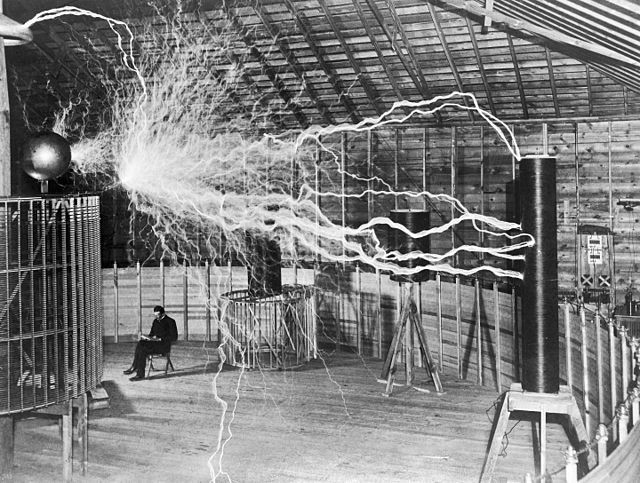
A final vein of conspiracies can be found when examining resources on the ‘source’ of the Russian Flu. As the epidemic developed, theories can be found which suggest that influenza was not an individual infection, but in fact simply an ‘influence’, an ‘electrical state of atmosphere’ with the ability to ‘exercise influence’ on the nervous system.13 Other theories simply denied its existence as an independent infection altogether14, with some, like Dr. T. Glover Lyon, believing that various changes to society caused a ‘strain on the nervous system’ that led to the severity of the influenza.15 He points toward the introduction of railways, the new telegraphs, and irregular and rushed eating at restaurants for the deterioration of their mode of life, and thus their susceptibility to the infection.16 Even this point has a connection to the modern response to COVID-19, often working in conjunction with fears of foreign influence. As Ashleigh Haw writes:
‘Covid-related conspiracy theories, for example, routinely contained a racial element, including claims that the virus was bioengineered in a Wuhan lab, that it was created by the Chinese government to facilitate the roll-out of 5G mobile technology, and that Melbourne’s second wave of infections was caused by Muslims celebrating Ramadan’.17
Overall, it can be seen that many of these conspiracies found when researching media surrounding the Russian Flu pandemic (1889-1895) not only complicated the public’s relationship with both medicine and the epidemic itself, but anticipated fears that emerge again in the modern era. It is through conducting these kinds of research programs that we can learn from these historic connections and thus apply our understanding to future public communications in times of epidemics and pandemics, like COVID-19.
Lily Burke
Lily Burke is a fourth and final year undergraduate student in a Bachelor of Advanced Humanities with the University of Queensland. She is undertaking an extended major in Western Civilisation, and in her 2025 honours year she will be conducting research into the cultural impact of feminist retellings of Greek Mythology, specifically those depicting the Trojan Mythic Cycle. Lily joined the UK Media and Epidemics team for a 6-week period over the UQ Summer Research program, under the supervision of PI Melissa Dickson.
You can find Lily’s Meet the Team blog here.
- Alden, W. L. “The Purple Death”. Cassell’s Family Magazine, Jan 1895, pp. 112-119, (116). ↩︎
- Ibid., 112. ↩︎
- Ibid., 116. ↩︎
- Wells, H. G. “The Stolen Bacillus”. The Short Stories of H. G. Wells, Project Gutenberg, August 2007, https://gutenberg.net.au/ebooks06/0609221h.html#c11 ↩︎
- Wells, H. G. The Shape of Things to Come. Penguin, 15 June 2005, p. 169. ↩︎
- Lim, Hyeyoung, et al. “COVID-19 Pandemic and Anti-Asian Racism and Violence in the 21st Century”. Race and Justice, vol. 13 no. 1, pp. 3-8, https://pmc.ncbi.nlm.nih.gov/articles/PMC9676106/ ↩︎
- “INFLUENZA.” The Lancet, vol. 136, iss. 3504, October 25 1890, pp. 871-872; “HUNTERIAN SOCIETY.” The Lancet, vol. 165, iss. 4263, May 13 1905, pp. 1270-1272. ↩︎
- “THE NERVOUS SEQUELAE OF INFLUENZA.” The Lancet, vol. 142, iss. 3648, July 29 1893, pp. 279-280 (279). ↩︎
- “EXPERIMENTAL IMMUNITY FROM INFLUENZA.” The Lancet, vol. 142, iss. 3669, December 23 1893, pp. 1587. ↩︎
- “The British Medical Association: Meetings at Bristol”. The Lancet, Vol. 144, No. 3701, Aug 04, 1894, pp. 286-299 (291). ↩︎
- Conrad, Joseph. The Secret Agent. Penguin, 24 September 2007. ↩︎
- “Covid: Anti-vaccination protests held in Australia ahead of rollout”. BBC, 20 February 2021, https://www.bbc.com/news/world-australia-56137597, accessed: 24/02/25. ↩︎
- “INFLUENZA.” 871. ↩︎
- “THE NERVOUS SEQUELAE OF INFLUENZA” 279; “HUNTERIAN SOCIETY” 1270. ↩︎
- “HUNTERIAN SOCIETY” 1270. ↩︎
- “HUNTERIAN SOCIETY” 1270. ↩︎
- Haw, Ashleigh. “Covid-19, Migration, and Racism in Australia: Key Challenges and Research Directions”. Journal of Intercultural Studies, vol. 45, iss. 3, 23 May 2024, pp. 381-391 (383). ↩︎


