
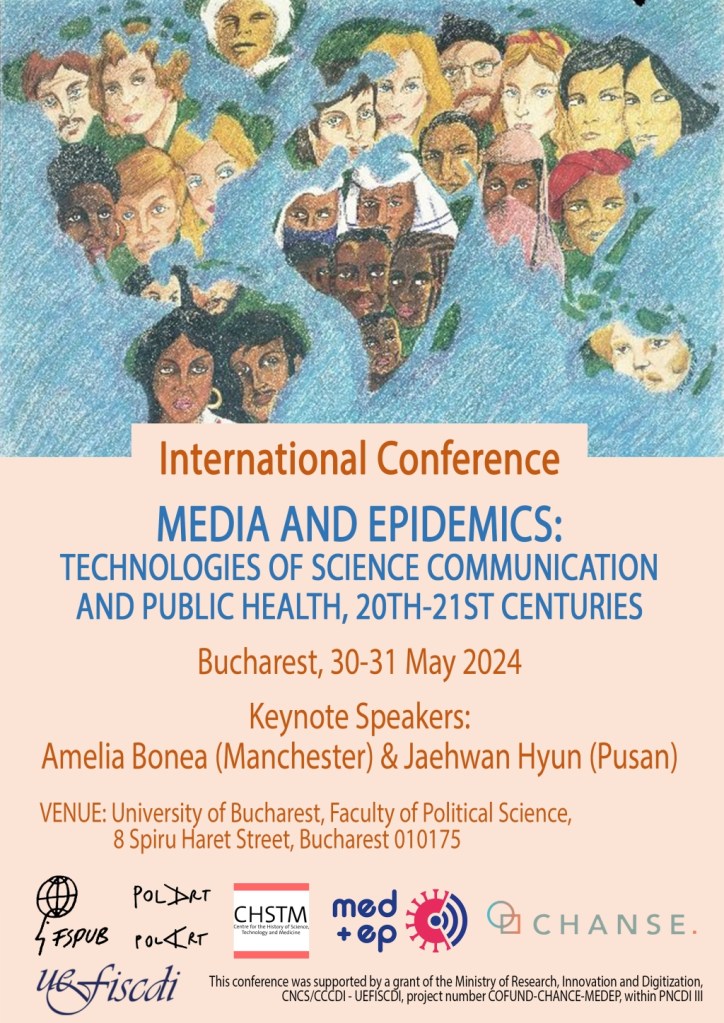
International Conference:
Media and Epidemics: Technologies of Science Communication and Public Health, 20th-21st Centuries
30-31 May 2024, University of Bucharest, Romania
Venue: University of Bucharest, Faculty of Political Science, 8 Spiru Haret Street, Bucharest 010175 (find on Google Maps)
Organizers: Media and Epidemics Project, Faculty of Political Science, University of Bucharest, in collaboration with the Centre for the History of Science, Technology and Medicine, University of Manchester
Conference Programme
Thursday, May 30
9:00 – 9:10
WELCOME
IRINA NASTASĂ-MATEI (Bucharest)
9:10 – 10:10
KEYNOTE
AMELIA BONEA (Manchester)
Infectious technologies: Telegraphs and telephones in medical practice and epidemic management
10:10 – 10:30 Coffee break
10:30 – 11:50
PARALLEL PANEL 1:
Communicating health: Visuality, technology, epistemology
Chair: JAEHWAN HYUN (Pusan)
HIRO FUJIMOTO (Heidelberg)
Utilizing film for health education in 1920s and 1930s Japan: The Ministry of Home, medical professions, and filmmakers
DALIA BATHORY (Bucharest)
Technologies of communication, education and health control targeting children: Red Cross campaigns in Socialist Romania
JANELLE WINTERS (Manchester)
Viral communications: Cinematic epistemology, norm cascades, and clinical trial evidence during the COVID-19 pandemic
10:30 – 11:50
PARALLEL PANEL 2:
Epidemic management as public diplomacy/ soft power
Chair: MELISSA DICKSON (Queensland)
ŁUKASZ MIESZKOWSKI (Warsaw)
Infected with soft power: The American Polish Typhus Relief Expedition, 1919-1920
ŞTEFAN BOSOMITU (Bucharest)
Between prophylaxis and propaganda: The control of public health crises in communist Romania: A case-study of tuberculosis
BOGDAN IACOB (Bucharest)
The eradication of malaria in Romania: A global showcase
11:50 – 13:30
PARALLEL PANEL 3:
Preventing and managing epidemics: Media, gender and humanitarian aid
Chair: MAGDALENA ZDRODOWSKA (Warsaw)
FLORIAN GRAFL (Ulm)
Transnational Perspectives on Health Posters to Combat Venereal Diseases in the First Half of the 20th Century
GRAEME GOODAY and EMILY REES KOERNER (Leeds)
Technoscience for an era of global existential threat: Humanitarian projects in women’s Cold War conferences
AYA HOMEI (Manchester)
Media technology and Japan’s cooperation in family planning with China in the 1980s
LUCIANA JINGA (Bucharest)
Media, humanitarian aid and the outburst of paediatric AIDS in Romania (1990-2000)
11:50 – 13:30
PARALLEL PANEL 4:
Epidemiology, material epistemology and the media of science
Chair: CAMELIA ZAVARACHE (Bucharest)
LUKAS ENGELMANN, JANA LOHROVA, CHRISTOS LYNTERIS and JOHN NOTT (Edinburgh and St Andrews)
Tabulation and the material epistemology of epidemiology: The case of the Indian Plague Commission, 1898-9
CAROLINA MAYES and RHODRI LENG (Edinburgh)
Containing complexity: The emergence of genetic epidemiology in and through science media, 1900-1990
SŁAWOMIR ŁOTYSZ (Warsaw)
From denial to fear: Changing narratives of the AIDS/HIV crisis in late socialist Poland
KATERINA VLANTONI and ATHANASIOS BARLAGIANNIS (Athens)
The public destiny of scientific research: The case of an observational study about in-hospital mortality of COVID-19 patients in Greece
13:30 – 14:30 Lunch
14:30 – 15:50
PANEL 5:
Race, media and public health crises
Chair: AMELIA BONEA (Manchester)
VANESSA NORTHINGTON GAMBLE (George Washington)
Black dispatches from an epidemic: African American newspapers and the 1918 Influenza Epidemic
DOMNICA GOROVEI (Bucharest)
Representations of African health crises in the Romanian communist journal Lumea (1960s-1980s)
VICTORIA SHMIDT (Graz)
Anti-pandemic campaigns as a channel of racialization of ethnic minorities: A global pattern?
Friday, May 31
9:10 – 10:10
KEYNOTE
JAEHWAN HYUN (Pusan)
Masks and gender in post-Great Influenza Epidemic media in colonial Korea
10:10 – 10:30 Coffee break
10:30 – 11:50
PANEL 6:
Epidemic fictions and infectious metaphors
Chair: HIRO FUJIMOTO (Heidelberg)
EMILY VINCENT (Birmingham)
‘He was shivering with a sort of ague’: Influenza and Oscar Wilde in fin-de-siècle Britain
MELISSA DICKSON (Queensland)
‘The nineteenth century up-to-date with a vengeance’: Spreading vampirism and Russian influenza across Bram Stoker’s Britain
ELEN VAN LAER (Independent researcher)
Imagery about a virus: More contagious than the virus itself? Metaphors used in Flemish and Dutch written press in the coverage of HIV and AIDS since the invention of combination therapy (1996)
11:50 – 13:00 Lunch
13:00 – 14:40
PARALLEL PANEL 7:
Languages, narratives and memories of epidemics
Chair: AYA HOMEI (Manchester)
STEFAN STRUNZ (Dresden)
Preventing epidemics at home: The Dresden Hygiene Museum’s didactic media on housing, 1912-1933
MAGDALENA ZDRODOWSKA (Warsaw)
Museum as medium: Exhibitions on epidemics
IRINA NASTASĂ-MATEI (Bucharest)
Transnational epidemics, national cure: the mass-media in communist Romania on the Polidin vaccine
MAGDALENA DUNAJ (Warsaw)
Whose is the epidemic? Double binding of sign language users
13:00 – 14:40
PARALLEL PANEL 8:
Epidemic management, emotions and war
Chair: GRAEME GOODAY (Leeds)
JOE MANOCK (Manchester)
‘A woeful crescendo of death’: Emotions, state critique and volunteerism during the Influenza epidemic of 1918-1919
ISLAY SHELBOURNE (St Andrews)
‘Great is the modern press, and great the misjudgement by some of its members…’ Newspapers, doctors, and challenges to Southern Californian medical expertise during the 1918-19 Influenza Pandemic
ILONA DAUW (Louvain/Leipzig)
Managing an epidemic during and after a war: The place of the ‘Spanish’ flu in the Belgian and Polish press (1918-1920)
CAMELIA ZAVARACHE (Bucharest)
The encephalitis epidemics in post-war Romania, 1919-1925
14:40 – 15:00 Coffee break
15:00 – 16:00
PANEL 9:
Performing epidemics
Chair: IRINA NASTASĂ-MATEI (Bucharest)
SALLY SHUTTLEWORTH (Oxford)
Contagion Cabaret in the Time of COVID
IULIANA DUMITRU, RUCSANDRA POP (Fragile Society, Bucharest)
COVID 19 experiences alchemized through arts. A case study on script writing and film making with high school students
CFP International Conference:
Bucharest, 30-31 May 2024
Media and Epidemics: Technologies of Science Communication and Public Health, 20th-21st Centuries
Organizers: Media and Epidemics Project, Faculty of Political Science, University of Bucharest, in collaboration with the Centre for the History of Science, Technology and Medicine, University of Manchester
Place and date: Bucharest, 30-31 May 2024
Abstracts submission deadline: 31 January 2024
Epidemics provide significant opportunities to reflect on the ways in which media, technology and society are co-constituted. As medical and social phenomena, they tend to be highly mediatized events, although the limits and local inflections of that mediatization are yet to be subjected to sustained critical attention in both historical and contemporary settings. Moreover, as the Covid-19 pandemic has reminded us, outbreaks of infectious diseases represent a veritable test for a country’s underlying socio-economic and political structures. This includes the ability to harness technologies and infrastructures of communication to overcome public health crises, by implementing population surveillance measures, communicating with broader publics, coordinating epidemic responses or devising strategies of preparedness against future outbreaks. By becoming testing grounds for various technologies of epidemic management (e.g., Lynteris 2018), epidemics also accelerate innovation, adaptation and change, while highlighting inequalities of access, legal, ethical and privacy dilemmas, questions of public trust, effective communication of science and (mis)information overload. This is particularly visible in the disproportionate impact of epidemics on groups that suffer from higher degrees of socio-economic marginalization, such as women, who represent the majority of primary caregivers, ethnic minorities and immigrants, who are often targeted as disease carriers, or persons with disabilities, who are frequently excluded from decision-making processes and have limited access to public health information.
This conference seeks to explore, from historical and contemporary, as well as trans-disciplinary and trans-regional perspectives, the role of media and communication technologies in the making and management of epidemic outbreaks since the beginning of the twentieth century. We welcome submissions from across the humanities and social sciences, pertaining to any area of the world, that engage with the following topics, but are not restricted to them:
- The role of state and non-state actors (medical and public health professionals, health advocates and activists, media and international organizations) in epidemic management.
- The relationship between international organizations and media in the context of public health crises.
- The intersections of media and marginalization in epidemic outbreaks, e.g., how socio-economic marginalization (of women, young people, ethnic minorities, immigrants, persons with disabilities) shapes access to media and communication technologies.
- Historical and contemporary strategies for the management of medical (mis)information and the role of media and communication technologies therein.
- Debates about medical professionalization, expertise and trust in a changing media landscape.
- Environmental communication during epidemic outbreaks.
- The transnational and transmedial study of epidemics, media and circuits of communication.
- The language by which diseases are articulated and understood, and the critical interchange between literature and socio-political uncertainties about disease, vaccination and invasions of the mind and body.
Keynote speakers:
Dr Amelia Bonea (University of Manchester) & Dr Jaehwan Hyun (Pusan National University)
Submission guidelines
Abstracts of max. 250 words, along with a brief biographical note, should be submitted to MEDEPconference@gmail.com by January 31, 2024. We welcome submissions from early career as well as more established scholars based in any area of the world. Limited funding might be available to contribute towards travel expenses, depending on the overall number of applicants and their financial circumstances. For any queries, please contact Dr Irina Nastasă-Matei at the above email address.
The conference is supported through a grant from the Romanian Ministry of Research, Innovation and Digitization, CNCS/CCCDI-UEFISCDI (Project no. COFUND-CHANSE-MEDEP, PNCDI III). It is organized as part of the CHANSE-funded project Media and Epidemics: Technologies of Science Communication and Public Health in the 20th and 21st Centuries. More information about the project is available at the following links:
 Media and Epidemics (MEDEP)