
“…epidemics are never only about pathogens. They are also filtered through the words of newspapers, proclamations, and popular accounts — words that, like folk tales, provided frameworks for speaking about disaster.”

What do nineteenth-century epidemics have to do with folklore, literature, print, and the ways that people imagined illness? For Ukrainian writers Taras Shevchenko (1814–1861) and Ivan Franko (1856–1916), epidemic disease was not only a medical reality but also a cultural metaphor, deeply intertwined with folklore, newspaper accounts, and wider European traditions. Their works remind us that epidemic writing is as much about microbes and mortality as it is about fears, symbols, and morality.
Shevchenko’s Чума (The Plague, 1848)
Taras Shevchenko, the central figure of Ukrainian Romanticism, usually studied for his role in nation-building, also wrote strikingly about epidemic devastation. In his poem The Plague, he personifies disease as a grim female figure, “walking with a shovel,” clearing villages and leaving silence and starvation in its wake.1
Manuscript evidence shows that Shevchenko first drafted the first line of the poem as “Cholera walked with a spade” before revising it to “Plague walked with a shovel.”2 The change is telling.
In the 1840s, cholera was terrifyingly real — the catastrophic 1847–1848 epidemic killed around 700,000 people across nearly the entire Russian Empire, with 49 out of 55 provinces afflicted.3 Newspapers, provincial bulletins, and official reports documented its course, recording cordons, police measures, and mounting deaths. Civic officials such as Ivan Lov’iahin, mayor of Yekaterinoslav, described the “double scourge” of scurvy and cholera that devastated rural populations, especially serfs.4
Yet cholera, despite its overwhelming impact, was still a relatively new figure in the cultural imagination. Printed accounts emphasized numbers, decrees, and scenes of disorder, but they offered little in the way of imagery or myth. By recasting “cholera” as the older figure of “plague,” Shevchenko drew on centuries-old folkloric patterns that personified pestilence as a wandering woman or a silent shadow passing through villages.5 At the same time, he aligned Ukrainian poetry with a wider European Romantic tradition, where the “plague” in the works of Adam Mickiewicz, Alexander Pushkin, and others stood as shorthand for collective catastrophe. Shevchenko thus wove together the factual language of official reports and the imaginative register of folklore, giving voice to peasants whose suffering was barely noted in civic papers.
Franko’s Boa Constrictor (1878)
A generation later, Ivan Franko returned to epidemic memory in his naturalist novel Boa Constrictor, set during the 1831 cholera outbreak in Galicia. For Franko, the epidemic is both literal history and a metaphorical curse.
The protagonist, Herman Goldkramer, is a wealthy Jewish oil magnate haunted by childhood memories of poverty in Drohobych’s Lan district, where his parents perished in cholera. Franko describes Lan as a miasmatic hellscape — filthy, overcrowded, and stinking of tanneries and decay.6 His picture echoes not only oral memory, but also the journals and civic notices of the time, which listed daily numbers of the dead, published ordinances on street cleaning, and issued appeals to maintain order. Mortality reached 40–50% in some localities, and the press remarked that Jewish communities in Galicia and Volhynia were particularly hard hit.7
Franko’s understanding of cholera follows the miasmatic theory then current: that disease arose from foul air, soil, and vapors rather than from contagion in water. This model, repeated in medical treatises and popular pamphlets, shaped how people read about and imagined the epidemic. Yet for much of the nineteenth century, the actual microbe and its transmission remained uncertain. In 1854, the Italian physician Filippo Pacini observed the cholera vibrio under his microscope, while in the same year John Snow traced a London outbreak to the Broad Street pump, demonstrating that cholera was waterborne. Both insights, however, were largely ignored until Robert Koch’s identification of vibrio cholerae in 1883 altered the picture. Against this shifting backdrop of theory and discovery, Franko’s imagery — from the “infectious air” of Drohobych to the exotic landscapes in Herman’s home — placed Galicia’s cholera within both local accounts and a broader imagination of India as the “cradle of pestilence.”8
Mediating Between Folk Belief, Public Accounts, and Science

What unites Shevchenko’s The Plague and Franko’s Boa Constrictor is their role as mediators between folklore, printed records, and contemporary science. Drawing on the statistical language of cholera notices and the testimony of those he knew, Shevchenko reshaped epidemic experience into a folkloric allegory of “plague.” Franko, in turn, transformed the reports and ordinances of Galicia’s cholera years into a naturalist narrative of inherited trauma and social decay.
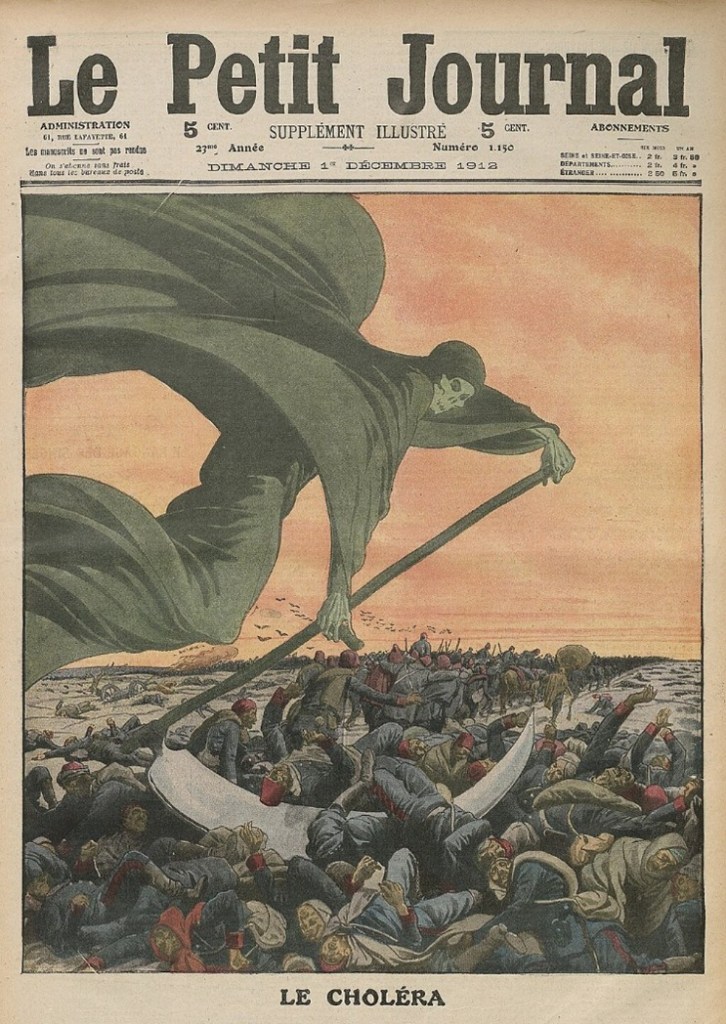
Together, they remind us that epidemics are never only about pathogens. They are also filtered through the words of newspapers, proclamations, and popular accounts — words that, like folk tales, provided frameworks for speaking about disaster. Shevchenko and Franko took these scattered voices of their age — official records, oral stories, medical speculations — and reshaped them into literature. In doing so, they turned cholera and plague into cultural symbols, preserving not statistics alone, but the moral and social weight of catastrophe.
Reading their works today invites reflection. Why did Shevchenko turn cholera into the more culturally laden plague? Why did Franko hold to the miasmatic theory even as other explanations were emerging? Their choices reveal how epidemics were experienced as total phenomena — medical, social, spiritual, and political — and how literature, alongside the press, helped transform calamity into meaning.
Dmytro Yesypenko
Dmytro Yesypenko is a researcher and Ph.D. candidate at the University of Alberta, affiliated with the Kule Folklore Centre and Canadian Institute of Ukrainian Studies. His work examines epidemics in Ukrainian and Polish literature within the broader frame of cultural history and medical humanities. He has authored and edited several books on Ukrainian literature and culture.
- Taras Shevchenko, The Complete Kobzar: The Poetry of Taras Shevchenko. Translated by Peter Fedynsky (London: Glagoslav Publications, 2013), 282-283. ↩︎
- Taras Shevchenko, “Mala knyzhka: Zbirka avtografiv [1850]” [The Little Book: A Collection of Autographs (1850)], Portal Shevchenka. Accessed August 10, 2025. http://kobzar.ua/item/show/5475 ↩︎
- Adolf Rashin, Naselenie Rossii za 100 let (1811–1913 gg.): Statisticheskie ocherki [The Population of Russia over 100 Years (1811–1913): Statistical Essays], ed. Stanislav Strumilin (Moscow: State Statistical Publishing House, 1956), 35; Konstantin Vasil’ev and Aleksandr Segal, Istoriia epidemii v Rossii: Materialy i ocherki [History of Epidemics in Russia: Materials and Essays] (Moscow: State Publishing House of Fiction Literature, 1960), 250. ↩︎
- Ivan Lovyagin, “Avtobiografiia” [“Autobiography”], Ekaterinoslavskii iubileinyi listok, no. 5 (1887): 38. ↩︎
- Aleksandr Potebnia, O nekotorykh simvolakh v slavianskoi narodnoi poezii [On Certain Symbols in Slavic Folk Poetry] (Kharkov: M. V. Potebnia, 1914), 222–28; Danylo Shcherbakivs’kyi, “Storinka z ukraїns’koї demonolohiї (Viruvannia pro kholieru)” [“A Page from Ukrainian Demonology (Beliefs about Cholera)”], Zapysky Ukraїns’koho naukovoho tovarystva v Kyїvi 19 (1925): 206; Nadiia Varkhol, “Zhinka-demon u narodnomu povir”ї ukraїntsiv skhidnoї Slovachchyny” [“The Female Demon in the Folk Beliefs of Ukrainians in Eastern Slovakia”], Pamiatky Ukraїny 1 (1992): 122; Svitlana Iahelo, “Demoholohichna proza ukraїntsiv Karpat: fantastychnyi element zhinochykh personazhiv” [“Demonological Prose of the Carpathian Ukrainians: The Fantastic Element of Female Characters”], Pytannia literaturoznavstva 82 (2011): 292; Marzena Marczewska, ‘Ja cię zamawiam, ja cię wypędzam…’ Choroba: Studium językowo-kulturowe [I Conjure You, I Expel You… Disease: A Linguistic-Cultural Study] (Kielce: Wydawnictwo Uniwersytetu Jana Kochanowskiego, 2012), 167. ↩︎
- Ivan Franko, Boa Constrictor and Other Stories, trans. Fainna Solasko (Moscow, [1957], 199-294. ↩︎
- Yurii Danch, [“Halychyna ta persha kholerna epidemіia”, [“Galicia and the First Cholera Epidemic”], Ukraїna 35 (2022): 49; Roderick E. McGrew, Russia and the Cholera, 1823–1832 (Madison: University of Wisconsin Press, 1965), 100. ↩︎
- In his monograph on cholera, Christopher Hamlin thoroughly examines the sources of the widespread prejudices of that time by referencing key works that first attributed cholera to Asian origins (Christopher Hamlin, Cholera. The Biography (New York, 2009), 39–52. ↩︎
 Media and Epidemics (MEDEP)


