
“Alden’s text is providing an example of the influenza pandemic’s indiscriminate nature of infection between classes, aligning with conclusions found in medical journals of the time.”

What are the main epidemics that your team focuses on?
I am a fourth and final year undergraduate student in a Bachelor of Advanced Humanities with the University of Queensland. I am undertaking an extended major in Western Civilisation, and in my 2025 honours year I will be conducting research into the cultural impact of feminist retellings of Greek Mythology, specifically those depicting the Trojan Mythic Cycle. I joined the UK Media and Epidemics team for a 6-week period over the UQ Summer Research program, under the supervision of PI Melissa Dickson. This Media and Epidemics Research Project is my first experience with academic research in a setting outside of my studies.
Our Media and Epidemics team is focussing on the Russian Influenza pandemic that occurred from 1889-1890 and is working to trace the development of this pandemic through its representations in different media, such as novels, poetry, medical journals, and other primary publishing sources from 1890-1905.
What have your key research question(s) been this month?
Within our team of three, we have each taken on the responsibility for a different ‘sub-topic’ of research under the broader focus on the Russian Influenza pandemic; my topic concerns references to influenza in science fiction works from 1890 to 1905, specifically W. L. Alden’s ‘The Purple Death’ (1895)and a selection of works by H. G. Wells. I am also examining the medical journals of the time for references to influenza, microbes, and bacilli. The broad research questions for the team as a collective are:
- What representations of influenza can be found in your sources?
- Is there a connection made to the Russian Influenza pandemic specifically, or can it be reasonably concluded? If not, then what illness is being referenced?
- What influences does your type of media have on the communication of the pandemic?
For my sci-fi sub-topic, the research questions are:
- How does sci-fi as a medium allow for the communication of the influenza pandemic?
- What conclusions can be made about the pandemic from these texts?
- Do they provide insight into the cultural conceptions of the pandemic that are absent in the medical records?
Do you have any images which resonate with your research that you would like to share?
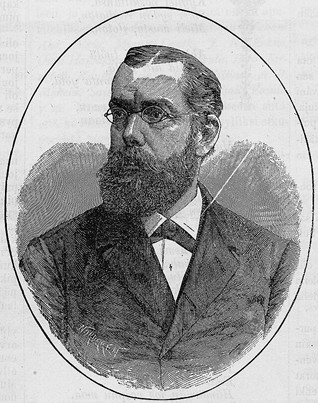
Pictured first is Heinrich Hermann Robert Koch, a German physician and microbiologist. He is referred to as the father of microbiology and medical bacteriology for his innovative discoveries of the causes of various infectious diseases, including anthrax, cholera, and tuberculosis.

Pictured second is Louis Pasteur, who is no less impressive, and a French chemist, microbiologist, and pharmacist. His studies specialised in vaccinations and hygiene practices, with his most remarkable developments being vaccines for rabies and anthrax. He and Koch are often said to share the ‘father of medical bacteriology’ title between them.
Both doctors are examples of the budding bacteriologist profession that is referenced in many science fiction texts addressing the influenza pandemic. While they made incredible breakthroughs in the medical field that we are certainly very grateful for today, it is understandable why scepticism and fear followed these discoveries. Just like the actions of Alden’s Professor Schwartz, it was feared that by learning the mechanics causing these diseases, corrupt bacteriologists would have the potential to recreate them and deploy them for their own uses. In particular, it is worth noting from a British perspective that the leading founders of this new scientific field were from France and Germany, two nations which receive many implicit and explicit references in the various texts examined.
Have you found any key differences between how the epidemic disease experiences of marginalised or minority individuals, and between those of the general population, have been communicated?
I have definitely found some interesting results in this area! In W. L. Alden’s The Purple Death (1895), the main character becomes entrapped in the ploys of his neighbour, a retired German physician who is trying to solve the problem of overpopulation in London by creating a disease which will kill two thirds of the working class. Professor Schwartz has created his ‘Purple Death’ in a very specific manner so that ‘[…] its ravages will be chiefly confined to those who have not the means of escape from the city.’ He believes that the anarchists in France focus too strongly on eliminating capitalists, and should instead focus on creating demand for labour, which he proposes to do by eliminating the majority of workers. What is most interesting about this scheme, however, is a comment that Professor Schwartz makes earlier in the story, when he is flaunting his diseased creations to the mortified narrator. Here, Professor Schwartz explicitly claims to be the cause of ‘the present variety of influenza’, having dropped his concoction of influenza spiked with malarial fever in St. Petersburg, the widely acknowledged origin city of the Russian influenza pandemic. This in itself is an incredible find for the project, but he then makes an odd comment: ‘I have always been very sorry that I lost that tube, for an epidemic of influenza can do no possible good, and does great harm.’1 How interesting, to have the anarchist say that an epidemic of influenza can do no good as he plans to murder most of the working class!
Because Professor Schwartz’s goals are known to us, we can understand that he means the influenza can do ‘no possible good’ for his purposes because it does not discriminately target the working class in the way diseases such as cholera were prone to, thus not achieving his solution for overpopulation. As a result, Alden’s text is providing an example of the influenza pandemic’s indiscriminate nature of infection between classes, aligning with conclusions found in medical journals of the time.
To what extent have you found that differing technologies can change how epidemics have been communicated? Are there any particular technologies that you wish to highlight?
The most notable difference I have discovered between different technologies of communication has been in examining the pandemic’s representation in medical journals in comparison to the sci-fi works. In the medical journals, as could be expected, there is a blunt examination of the symptoms and potential causes of the infection. It is often filled with medical jargon, and feels rather cold and detached, as it takes the format of a lab report. There is nothing inherently wrong with this, of course, and it provides invaluable information about not only the pandemic itself, but the methodology employed at the time to identify, categorise, diagnose, and treat the influenza. That being said, there is no sense of the public response to these conditions, or the ways that society is operating; I have found that this is the focus of the sci-fi works. Often the influenza itself is not merely a sickness, but a metaphor, or a harbinger of the rampant fear, mistrust, and danger felt by citizens of England at the time.
W. L. Alden’s ‘The Purple Death’ (1895), H. G. Wells’ ‘The Stolen Bacillus’ (1895) and Joseph Conrad’s The Secret Agent (1907) all connect the idea of influenza with the fears of foreign influence, the nascent bacteriologist field, and the potential for diseases like the influenza to be constructed and employed for terrorist purposes.2 In H. G. Wells’ The Shape of Things to Come (1933) he poses influenza as a recurrent attack on the human population, one that is employed in warfare and impairs the creation of international treatises.3 These texts offer amazing insight into the repercussions of the pandemic on English society, and the influences that politicised its operations.4
What has been your most surprising finding while working on the Media and Epidemics project?
The most surprising finding in my work so far has been the strong connection between bacteriology and French anarchism. It was first mentioned in W. L. Alden’s ‘The Purple Death’ (1895), as Professor Schwartz believes that germs, not bombs, should be the weapon of anarchists. H. G. Well’s ‘The Stolen Bacillus’ (1895), published in the same year, plays on similar themes of anarchists having access to deadly diseases and using them for terrorist acts. This connection between the two texts led me to Joseph Conrad’s The Secret Agent (1907), with its heavy focus on anarchy, which I read in conjunction with Jennifer Lynn Rideout’s ‘The Russian Flu as Extended Metaphor in Joseph Conrad’s The Secret Agent’ (2018). Rideout argues that secret agent Mr. Verloc’s family acts as a literal embodiment of the foreign infection of influenza from Russia, making several interesting points about the usage of ‘illness-related’ terminology to describe the Verloc family, and the fear of ‘random, unseen, and deadly’ forces of destruction, referring to both influenza and terroristic anarchy.5
- Alden, W. L. “The Purple Death”. Cassell’s Family Magazine, Jan 1895, pp. 112-119. ↩︎
- Wells, H. G. “The Stolen Bacillus”. The Short Stories of H. G. Wells, Project Gutenberg, August 2007, https://gutenberg.net.au/ebooks06/0609221h.html#c11; Conrad, Joseph. The Secret Agent. Penguin, 24 September 2007. ↩︎
- Wells, H. G. The Shape of Things to Come. Penguin, 15 June 2005, pp. 221-225. ↩︎
- Wells, H. G. “The Moth”. The Country of the Blind and Other Selected Stories, Penguin, 31 May 2007; Wells, H. G. “Jimmy Goggles the God”. The Short Stories of H. G. Wells, Project Gutenberg, August 2007, https://gutenberg.net.au/ebooks06/0609221h.html#c11. ↩︎
- Rideout, Jennifer Lynn. “The Russian Flu as Extended Metaphor in Joseph Conrad’s The Secret Agent (2018)”. Scientia et Humanitas, vol. 8 (2018), pp. 6-18, https://libjournals.mtsu.edu/index.php/scientia/article/view/1124, p. 15. ↩︎
 Media and Epidemics (MEDEP)