
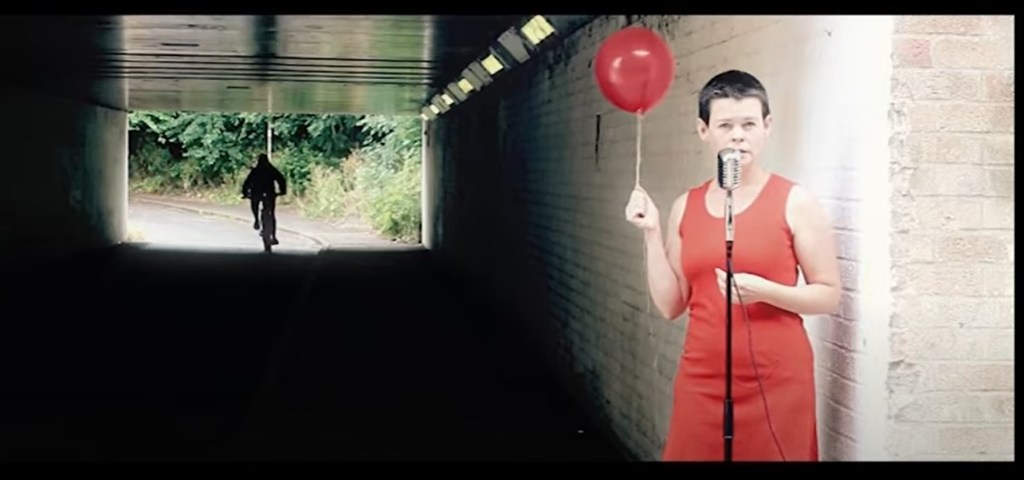
“Our Mistress of Ceremonies, with her gas mask and red balloon, strode across empty land and streetscapes around Oxford, whilst speaking with great intimacy to us, her captured, quarantined audience, scattered as we were, across the world.”
When COVID 19 struck in 2020, I had the unworthy thought that we were before our time. Working with the wonderful Chipping Norton Theatre, my team on the Diseases of Modern Life Project and I had created in 2017 a ‘Contagion Cabaret’, an evening of drama and song which also explored crucial social and ethical issues associated with the spread of epidemics. The Cabaret had played in multiple venues, and been a real success, but we had no record, precisely at the moment when its messages were most needed. Luckily, I was able to secure funding to create a film version. We forfeited the immediacy of theatrical performance, but the Cabaret’s new form enabled us to use the power of social media to distribute our work globally, in a technological mode of viral transmission.
Plague Storytelling
The original version of Contagion Cabaret was first performed in the atmospheric venue of the History of Science Museum in Oxford, where we were surrounded by scientific instruments, in a room which was the site of the original anatomy theatre in the university.
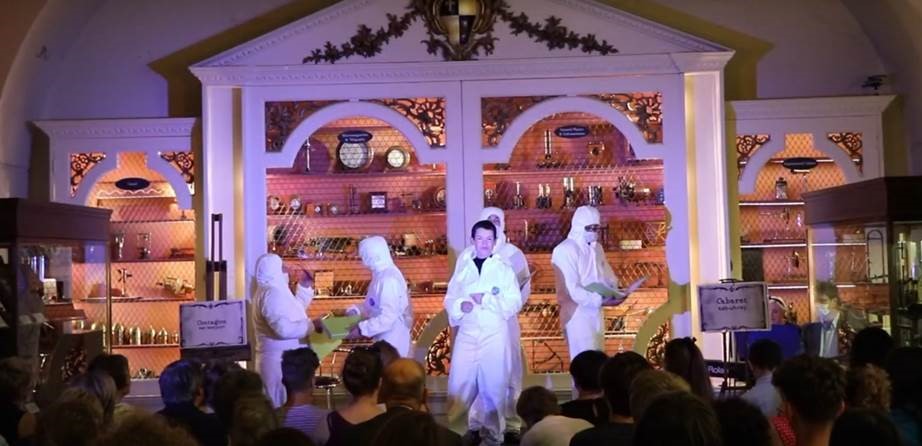
It was an intimate setting for an evening of fun and laughter, which also combined short talks by current medics, as we explored the past and present history of contagion, using short extracts from plays, and eye-witness and newspaper accounts, all interspersed with music and song. Sexual diseases and AIDS were prominent, but also experiences of the plague and the 1918 epidemic of Spanish Flu. The Cabaret was subsequently recreated for a variety of venues, from the Science Museum and British Academy in London, to Chipping Norton Theatre, and the Pitt Rivers Museum in Oxford, amidst its extraordinary ethnographic collections.
One of the reasons for staging the Cabaret was the belief that theatre can speak to people more powerfully than virtually any other medium. I was keen to draw on my own experience in this regard. As a young teenager in Sheffield, I had seen a production at the city theatre of a play about the devastating impact of the plague during 1665-6 in Eyam, a small village not far from Sheffield. Ring o’ Roses (1967), by the theatre’s resident playwright, Alan Cullen, told the story of the arrival of the plague in the village on a parcel of cloth, and the role the resident ministers played in convincing the villagers to cut themselves off from the rest of the world, so that they would not carry the plague elsewhere. It was an extraordinary story of moral courage – 260 of the village’s 800 or so residents were to die, but the plague was contained, thanks to the heroism and sense of social responsibility displayed by the villagers. The theatrical performance was electrifying. Today if you visit the village, there are plaques outside the houses, listing those who had died there during the plague.

The story of Eyam was central to our planning for the Cabaret (although I found, sadly, that Cullen’s play seems not to have been published, so we used a slightly later play by Don Taylor instead, The Roses of Eyam).
A Quarantined Audience
The arrival of COVID-19 placed all the issues we had explored in Contagion Cabaret in stark relief. We reworked the materials, adding new sources to heighten contemporary relevance, but also cutting scenes which might seem too painful or too insensitive, for a world where grief and anxiety were the dominant emotional notes. The logistical difficulties of creating a film version were immense, since we were filming in strict lockdown conditions (it helped greatly that our director, John Terry, and leading lady, Anna Tolputt, were married – in best-Brechtian tradition). We decided to make a virtue out of necessity, and adopted a form of ‘Blair Witch’ aesthetic of ‘found footage’. Most of the dramatic scenes were transformed into zoom conversations, echoing the strange conjunction of individual isolation with new forms of digital community which we all experienced. Our Mistress of Ceremonies, with her gas mask and red balloon,

strode across empty land and streetscapes around Oxford, whilst speaking with great intimacy to us, her captured, quarantined audience, scattered as we were, across the world.
We were delighted that the doctors who had spoken in our original performances were able to join our film production. In many ways, the film has become itself a historical document of the COVID era. Professor John Frater, an expert in HIV, addresses us fresh from running a COVID ward, and after his own bout of COVID. He paints an extraordinary picture of doctors, from diverse forms of medical specialism, coming together to work with COVID patients. At the time of filming, no viable vaccination was in sight, but the film clip captures the determined resilience displayed by doctors globally at this challenging time – the first moment in history when an epidemic was experienced simultaneously across the world.
Transmission: Digital and Viral
The emotional power of theatrical performance was inevitably diluted in the film version of Contagion Cabaret, with audience members watching largely in isolation in their own homes. We gained immensely, however, from the possibilities opened up by digital transmission. There is, for example, a permanent record (unlike Cullen’s lost play). We were also able to engage with schools, and received stunning entries in our competitions for COVID art and creative writing.
Our reach could also become global rather than local. Contagion Cabaret was featured as part of the ‘Contagion’ exhibition at the Science Museum, Bangalore, with members of the team taking part in an online discussion with Indian academics and doctors.
Viral transmission of viruses now happens at lightning speed due to our global connectivity, but media play a vital role in creating avenues for international dialogue (as well, I might add, unfortunately, for the promotion of misinformation). In its irreverent, and thought-provoking form, Contagion Cabaret offers a very different mode of engaging with the challenges of epidemics, from the plagues of ancient times, to the recent experiences of HIV and COVID, and no doubt, the further epidemics which are yet to come.
Watch the Contagion Cabaret here.
Professor Sally Shuttleworth
Professor Sally Shuttleworth (CBE, FBA, Senior Research Fellow in English Literature, University of Oxford) is a British academic specialising in Victorian literature and is on the Advisory Board for the Media and Epidemics project. From 2006 to 2011, she was Head of the Humanities Division at Oxford. She recently held a European Advanced Investigator grant for a five year project, ‘Diseases of Modern Life: Nineteenth-Century Perspectives’. She was also Principal Investigator for a large AHRC four year grant in the field of Science and Culture, on ‘Constructing Scientific Communities: Citizen Science in the 19th and 21st Centuries’ which she ran in partnership with the Natural History Museum, London, the Royal Society, and the Hunterian Museum at the Royal College of Surgeons.
 Media and Epidemics (MEDEP)