

At the Media and Epidemics: Technologies of Science Communication and Public Health, 20th-21st Centuries Conference, held at the University of Bucharest in May 2024, panellist contributions revealed the prominent position of newspapers in promulgating medical truths or untruths, of shaping perceptions of medical establishments, and of the impact of negative medical and media relations during pandemic periods. This was particularly resonant in the case study I presented, looking at the antagonistic relationship between newspapers and doctors in Southern California during the 1918-19 influenza pandemic.
Influenza in Southern California
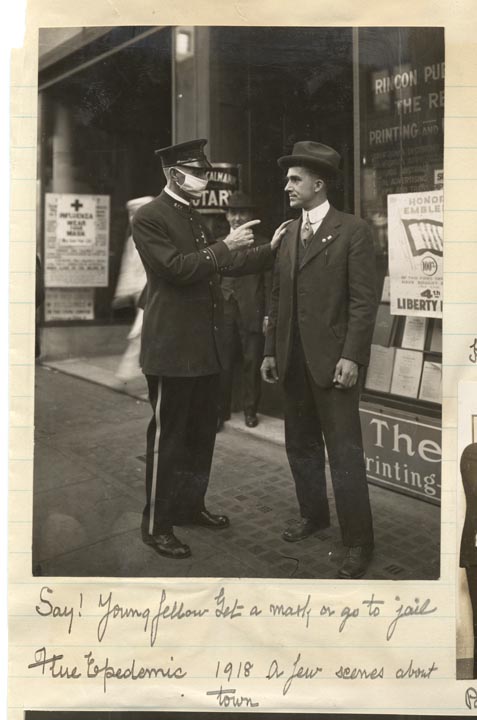
Flu arrived in California in the fall of 1918, where it would be responsible for at least 30,000 deaths and an even higher number of infections – the health officer for the city of Los Angeles estimated that there were over 75,000 infections in the city alone between October 1918 – March 1919.1 In response to rising cases, City Boards of Health across the state enacted a variety of measures to try and limit the spread of infection, including bans on public gatherings; the closure of schools, theatres and churches; quarantine for the sick; and mask mandates in some cities, including San Francisco and Pasadena.2 Though popular resistance to these measures was limited in Southern California, the pandemic did serve to stoke a fiery antagonism towards the state’s mainstream medical establishment within some of the region’s newspapers. By the winter of 1918, criticism of medical authority and expertise fuelled an inferno in the pages of the Los Angeles Times.
‘A deep-seated antipathy to the medical profession’
The Los Angeles Times was renowned for its antagonistic attitude towards ‘regular’ (meaning mainstream, Western, and accredited) medical practitioners even before the pandemic created new challenges for doctors’ authority and expertise. In January 1918, the Journal of the American Medical Association made a point of referencing the Los Angeles Times by name in an article about the nationwide dangers of a hostile press, stating that ‘The Times seems to have two obsessions, an undying hatred of labor unions and a deep-seated antipathy to the medical profession and medical science’.3 This antipathy became ever-more evident as the city of Los Angeles implemented pandemic prevention measures in November 1918, with the Times’ comments on mask wearing revealing the wider tensions between the newspaper and LA’s doctors during the period.
Hamilton Henry Dobbin, 1856-1930. Reference: California State Library.
‘You might as well wear a coal screen on your face as one of those masks’
‘Pen Points’, the Times’ daily column written anonymously by its staff, offered barbed commentary on that day’s news. Throughout the pandemic period these comments are largely focused on the end of WW1, however in almost every edition published during the winter of 1918-19, the column also included sarcastic comments directed at the medical field and its pandemic public health policies.
Masks feature prominently within these comments, despite the fact that the city of Los Angeles did not have an ordinance mandating their use. This ranged from offhand punchlines in the column’s jokes:
‘Do you yawn during a concert and twist your programme instead of being interested in the music? If so, you are suffering from an underdeveloped pituitary body located in the brain. Wear a mask’.
– ‘Pen Points’, Los Angeles Times, 27 December 1918.4
To outright critique of the mask policies and the doctors who implemented them:
‘Not so long ago the physicians were warning the women against the wearing of veils, claiming that they harbored germs. Now some of them recommend the wearing of masks. It is hard to get away with the docs’.
– ‘Pen Points’, Los Angeles Times, 11 November 1918; and 22 January 1919.5
‘You might as well wear a coal screen on your face as one of those masks, so far as keeping out flu germs is concerned’.
Mask wearing saw significant popular opposition in the north of the state, where ‘mask slackers’ formed an Anti-Mask League and defied masking ordinances in San Francisco, as well as closer to home in the southern Californian city of Pasadena where the Times reported that ‘Pasadena snorts under masks’ after becoming ‘a masked town, considerably to its own disgust’.6
For the majority of these citizens, opposition to mask wearing stemmed from perceptions of masks as inconvenient, uncomfortable, and for many sceptical doctors, inefficient in preventing flu, with some groups going further to call their mandatory wear as an unconstitutional infringement of personal liberty.7 However, for the Times, criticism of mask wearing was instead used as shorthand to sow distrust in medical authority and expertise more broadly. Choosing to wear a mask – as a highly visible object associated with the flu – was synonymous, in the Times staff’s eyes, with subscribing to ‘regular’ medicine’s understanding of contagion and disease. Calling into question the efficacy of masks through jokes and sarcastic comments thus allowed the newspaper to critique medicine more broadly and encourage their readers to adopt their ‘deep-seated antipathy’ during a global pandemic.
My research currently seeks to explore whether the Times’ antipathy was internalised by its readers, and, if so, the extent to which this impacted reactions to and understandings of influenza in Southern California in 1918. As the rich discussions at the Media and Epidemics conference showed, examining the relationships between medical professionals and the popular press, and especially the impacts of these relationships souring or becoming more hostile, is not only incredibly fruitful for historical work, but also highly prescient in the light of modern pandemic threats.
Islay Shelbourne
Islay Shelbourne is a PhD Environmental History candidate at the University of St Andrews. Her thesis explores how Southern Californian medical and civilian reactions to the 1918-19 influenza pandemic were framed by the state’s unique attitudes towards health and nature. She employs medical, environmental, and everyday life history methodologies within her work, as well as demographic and epidemiological analysis. She can be found on X @IslayShelbourne
- ‘FLU JUMPED DEATH RATE.: HEALTH REPORT FOR PAST YEAR SHOWS FIFTY THOUSAND CASES REPORTED: Health Report for Past Year Shows Fifty Thousand Cases Reported;’, Los Angeles Sunday Times, 13 Jul 1919, p.10. ↩︎
- For an overview of Californian public health responses to the pandemic see: Diane M. T. North ‘California and the 1918–1920 Influenza Pandemic’, California History, (2020), 97.3, 3-36. ↩︎
- ‘Newspapers and the Doctor’, Journal of the American Medical Association, 70.1 (1918), p.30. ↩︎
- Pen Points’, Los Angeles Times, 27 Dec 1918, p.12. ↩︎
- ‘Pen Points’, Los Angeles Times, 11 Nov 1918, p.12; ‘Pen Points’, Los Angeles Times, 22 Jan 1919, p.16. ↩︎
- ‘PASADENA SNORTS UNDER MASKS: Sixty Violators of the New Flu Law are Arrested First Day, Los Angeles Times, 21 January 1919, p.13. ↩︎
- Alfred W Crosby, America’s Forgotten Pandemic: The Influenza of 1918, 2nd ed. (New York: Cambridge University Press, 2003), pp.105-113. ↩︎
 Media and Epidemics (MEDEP)