
“It will be interesting to see if and how COVID-19 presents itself in alternative forms of media in the future through literature, film, and art as both a roll-on effect from the pandemic and to communicate the significance of the event to future generations.”

What are the main epidemics that your team focuses on?
I am a third-year student at the University of Queensland, Australia, where I major in Microbiology, Professional Writing and Communication, and Philosophy.
I joined the UK Media and Epidemics team for a short period under the supervision of PI Melissa Dickson as a recipient of a Winter Research Scholarship from the University of Queensland, Australia. The focus of our scholarship team was the COVID-19 pandemic.
What have your key research question(s) been this month?
How did factors in the lead up to the COVID-19 pandemic affect the success of the healthcare system in the UK? This included researching:
- trends in the articles published about the health system in the years 2010, 2011, 2016, and 2017,
- public concerns and topics of interest in relation to the health system,
- the concerns of healthcare workers,
- the reasons behind staff entry and exist of the medical profession, and
- misconduct and whistle blowing within the medical industry.
- working conditions during the pandemic,
- working conditions in the John Radcliffe hospital from 2020 to 2024,
- covid statistics, restrictions, and policies in the UK, and
- the responses of notable groups to the pandemic including the government, the public, and the hospital employees.
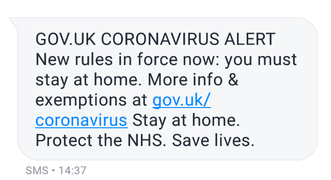
Reference: March 24, 2020 on Wikimedia.
Have you found any key differences between how the epidemic disease experiences of marginalised or minority individuals, and between those of the general population, have been communicated?
We saw reports of higher instances, and greater impact of illness, within the Black, Asian and Minority Ethnic (BAME) community of the UK. Among those working in high exposure zones like hospitals, higher fatalities were reported with 90% of all deaths among doctors and consultants attributed to members of the BAME community. Significant mention of BAME individuals were present in COVID-19 obituaries from local news sources.12
To what extent have you found that differing technologies can change how epidemics have been communicated? Are there any particular technologies that you wish to highlight?
Occurring in the digital age, the pandemic had enormous coverage from all major media sources. One particularly unique representation of the pandemic was aired in the form of a TV drama which displayed the difficulties faced by health professionals and failings of the health system during COVID. It will be interesting to see if and how COVID-19 presents itself in alternative forms of media in the future through literature, film, and art as both a roll-on effect from the pandemic and to communicate the significance of the event to future generations.3
What has been your most surprising finding while working on the Media and Epidemics project?
Generally, it is quite surprising how socio-political events can have such profound and lasting effects through different channels of communication. Within our research I observed clear trends in information surrounding events like elections, Brexit, strikes, and of course COVID-19. Post-COVID-19, one trend that was interesting to observe was that while many parties felt that COVID-19 exposed many of the issues present in the healthcare system, many also talked as if it would be the push for a better NHS. I found it inspiring that this attitude was shared by both healthcare workers and the public.4
- Ahmed Aftab S. Tackling COVID-19’s effect on BAME doctors [Internet]. BMA, [Updated 2020 May 21; cited 2024 Jul 18]. Available from: https://www.bma.org.uk/news-and-opinion/tackling-covid-19-s-effect-on-bame-doctors#:~:text=More%20than%2090%20per%20cent,COVID%2D19%20on%20these%20groups. ↩︎
- Bamrah JS, & Chand K. The best birthday present for the NHS? An end to its institutional racism. The Guardian [Internet]. 2020 Jul 3 [cited 2024 Jul 17]. Available from: https://www.theguardian.com/society/2020/jul/03/best-birthday-present-nhs-end-institutional-racism ↩︎
- Mangan L. Breathtaking review – a shockingly vivid picture of life as a doctor during Covid. The Guardian [Internet]. 2024 Feb 9 [cited 2024 Jul 17]. Available from: https://www.theguardian.com/tv-and-radio/2024/feb/19/breathtaking-review-a-shockingly-vivid-picture-of-life-as-a-doctor-during-covid ↩︎
- Thorlby R, Gardner T, Everest G, Allen L, Shembavnekar N, Fisher R, Dunn P, Turner-Berry T, Fraser C, Briggs A, Alderwick H. The NHS Long Term Plan and COVID-19. Assessing progress and the pandemic’s impact. The Health Foundation [Internet]; [updated 2021 Sep; cited 2024 Jul 18]. Available from: https://www.health.org.uk/publications/reports/the-nhs-long-term-plan-and-covid-19 ↩︎
 Media and Epidemics (MEDEP)