

In pandemic research, “the memory of trauma should propel us forward”.
On 1st and 2nd July 2024, the UK team of the Media and Epidemics project presented a collaborative research poster at the International Pandemic Sciences (IPS) Conference. Hosted by the Pandemic Sciences Institute at the University of Oxford, the IPS conference invited multidisciplinary academic researchers, policy makers, and scientists from around the globe to share and further world-leading research on past, present, and future pandemics. Its key takeaway? How can we learn from diseases of the past to prepare for global pandemic futures?
In line with the conference’s theme of ‘Collaboration Beyond Boundaries’, delegates travelled from over 60 countries to share global perspectives on a diverse range of historic and emergent epidemic threats, including Covid-19, Nipah virus, and subtypes of influenza, especially the H5N1 strain. Papers and research posters were encouraged to transcend disciplinary boundaries to facilitate truly interdisciplinary discussions; this led to the more expected fields of epidemiology, medicine, and immunology being placed alongside leading developments in ethics, history, and anthropology. Challenging global issues were addressed concerning equitable vaccine distribution, threats of political misinformation, and approaches to determining ethical disease priorities which centered debates around who should choose which disease or geography deserves the most attention or resources.
“Collective amnesia”
Representatives from the World Health Organisation (WHO), the Centers for Disease Control and Prevention, and the Pandemic Sciences Institute all reiterated the importance of learning lessons from the often beleaguered histories of pandemics. Maria Van Kerkhove, WHO Director of Epidemic and Pandemic Preparedness and Prevention, stressed that in pandemic research, “the memory of trauma should propel us forward”. Head of the Division of Clinical Public Health at the University of Toronto, Ross Upshur, also asserted a “collective amnesia or collective narcolepsy” when recalling discourse around previous pandemics, such as Ebola, in which media outlets frequently impressed the need to “learn lessons” and respond to “wake up calls” when faced with reemergent pathological threats.1
The IPS conference overlapped with many of the Media and Epidemics project’s findings, especially concerning how a diverse range of global outbreaks (including influenza, HIV/AIDS, and Covid-19) have been represented and mediatised. For instance, the mistrust of messages and messengers during the Covid-19 outbreak reignited a pervasive pandemic threat: the spread of misinformation and an erasure of trust, known as ‘infodemics’. Speakers consequently highlighted how essential the creation of reliable and accurate storytelling narratives are during a pandemic so that global authorities can rebuild trust and disseminate impactful communications.
Storytelling the Flu
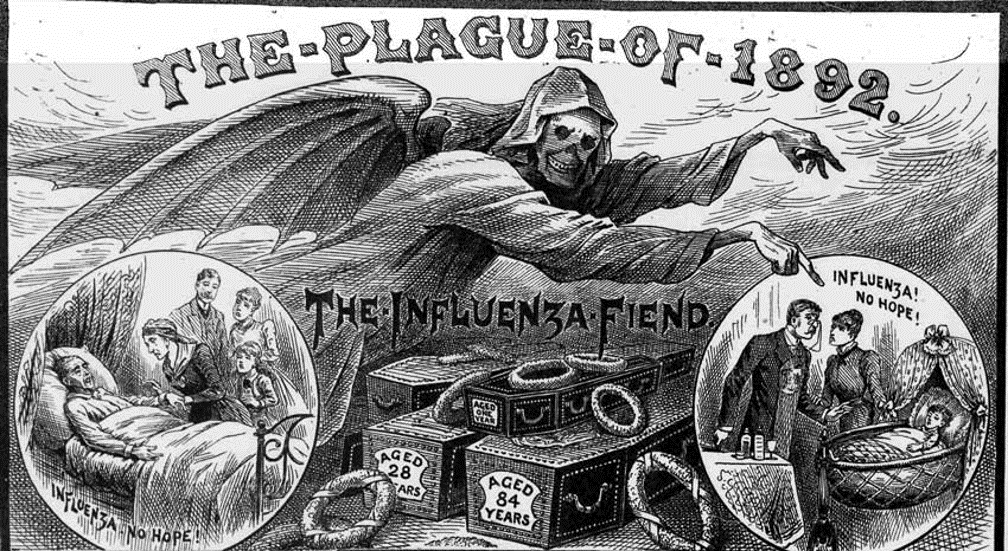
To underscore the centrality of storytelling, the UK team presented a research poster (featured above) on ‘Influenza Pandemics in British Literature and Media, 1889–1920’ which showcased narratives from two major influenza pandemics: the so-called ‘Russian Flu’ of the 1890s and the 1918 pandemic. Using text boxes and visual aids, the poster provided an overview of the project’s key methods, shared its interdisciplinary methodology, highlighted key findings, and directed readers to concluding remarks. Striking Gothic images from late nineteenth-century periodicals and book covers of key pandemic literature reinforced the bold ways in which historic newspaper media and fiction could both terrify and tantalise at a time when influenza epidemics were sweeping across Britain.
Respondents to the poster were curious to learn more about the role of textual narratives in shaping both past and present pandemic discourse, while many were struck by the poster’s concluding message, one which stressed the need to look to literary cultures of the epidemiological past to inform our pandemic futures.
Emily Vincent
UK Team
—
- See also: Smith, M.J., Upshur, R.E.G. Learning Lessons from COVID-19 Requires Recognizing Moral Failures. Bioethical Inquiry 17, 563–566 (2020). https://doi.org/10.1007/s11673-020-10019-6 ↩︎
 Media and Epidemics (MEDEP)