
“Some [doctors] felt extremely burnt out at the height of the pandemic, while others remember being protected by stress by camaraderie amongst colleagues.”

What are the main epidemics that your team focuses on?
As part of the UK team for the Media and Epidemics project, Gareth Dickson and I are investigating contemporary perspectives on COVID-19. Melissa Dickson and Emily Vincent are taking a historical standpoint to investigate the Russian Flu (1889-90), the Spanish Flu (1918), and the milder Asian Flu (1957-8) and Hong Kong Flu (1968).
What have your key research question(s) been this month?
- How did the COVID pandemic affect the roles and lives of UK doctors?
- How did high-risk and low-risk patient groups experience the COVID pandemic?
- What does it mean to live in a post-COVID world, and to what extent have we achieved this milestone? In which ways, both negative and positive, has the COVID pandemic influenced UK medical practice in 2024?
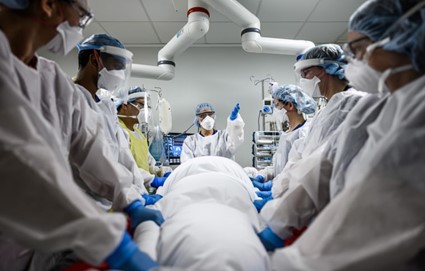
Have you found any key differences between how the epidemic disease experiences of marginalised or minority individuals, and between those of the general population, have been communicated?
Doctors have identified anecdotally that elderly people and minority ethnic groups were affected by COVID to a higher degree. Studies confirm both of these trends, but the disproportionate suffering of minority ethnic groups might not be common knowledge.1 Linguistic and cultural barriers may limit communication between patients and doctors and affect treatment experiences.
To what extent have you found that differing technologies can change how epidemics have been communicated? Are there any particular technologies that you wish to highlight?
The spread of anti-vaxx rhetoric through social media was reflected in UK ICU departments.2 Some doctors report that, towards the end of the pandemic, patients entering hospital were often unvaccinated people who had often turned down the vaccine because of ‘beliefs they got off Facebook’.3
Some doctors have also highlighted discrepancies between large-scale media messaging and actual hospital circumstances; for instance, an inability to source more equipment being reframed as a change to equipment requirements in public briefings.
What has been your most surprising finding while working on the Media and Epidemics project?
The diversity in perspectives among doctors! Some felt extremely burnt out at the height of the pandemic, while others remember being protected by stress by camaraderie amongst colleagues. Also, some experienced COVID predominantly as a catalyst for pre-existing negative trends in the healthcare system, while some have a more mixed perspective, suggesting that with these new demands came learning and growth amongst doctors.
Are there any upcoming events, workshops, artistic partnerships, or publications that your Media and Epidemics team would like to promote for this month, or next?
The UK team will be preparing their research presentations to take to the Media and Epidemics conference in Bucharest, taking place between 30th – 31st May 2024. Find out more about the conference here: Events – Media and Epidemics (MEDEP) (mediaepidemics.com).
- For an overview of disparities in UK COVID cases, this report demonstrates these trends for age and ethnicity: report here ↩︎
- A systematic review of social media and attitudes towards COVID vaccination: https://www.ncbi.nlm.nih.gov/pmc/articles/PMC9120591/; and this source shows a relationship between social media usage and public doubts of vaccine safety: https://gh.bmj.com/content/5/10/e004206 ↩︎
- An insight into the virality of certain types of anti-vaxx messaging on Facebook: https://www.ncbi.nlm.nih.gov/pmc/articles/PMC9301555/ ↩︎
 Media and Epidemics (MEDEP)